Here is something that happens at Noisebridge approximately three to six times a day: someone — maybe you, maybe a visitor who heard about the place and looked us up on their phone before walking over from BART — tries to load noisebridge.net, and gets nothing.
A timeout. An error page. The wiki, which is the closest thing Noisebridge has to institutional memory, a living document of eighteen-plus years of anarchist experiments in collective space-making, is just gone. And here is the thing I need you to understand, the thing I got wrong when I first started thinking about this problem: it does not simply "come back." The phrase "it always comes back" implies that what we have is a recurring outage problem — inconvenient, embarrassing, fixable in principle if someone just had enough time. What we actually have is a permanent state of siege in which the wiki is operational only because someone is doing continuous, specialized, exhausting defensive work to keep it that way, and the moment that work pauses, the siege wins.
The reason noisebridge.net goes down is not mysterious, which is almost the annoying part — it would be easier, emotionally, if there were a villain, a specific bad actor whose motives you could evaluate and whose decisions you could appeal to. It's not a hardware failure. It's not a misconfiguration. It's not the kind of technical debt you could theoretically pay off if you just had a productive weekend and enough coffee. The reason noisebridge.net goes down is that there are bots — AI training crawlers, scraper pipelines, data-harvesting agents of every description and level of sophistication — hitting the server with the sustained, joyless, utterly indiscriminate efficiency of industrial machinery that has no concept of the thing it is consuming or the people who made it.[1]
The numbers, when you look at them directly, have the quality of a particular kind of nightmare. Jonathan Lee, who operates Weird Gloop — one of the largest independent wiki hosting operations on the internet, running the Minecraft Wiki, the Old School RuneScape Wiki, and others — has documented what the siege looks like from inside the walls: approximately 250 million bot requests per month, roughly 100 per second as a baseline, with spikes that exceed 1,000 requests per second and are operationally indistinguishable from deliberate denial-of-service attacks.[2] Ninety-five percent of server issues in the wiki ecosystem this year stem from problematic scrapers. Without continuous active mitigation — not a one-time fix, not a configuration change you make and then move on from, but ongoing defensive work — bot traffic would consume roughly ten times more computational resources than all legitimate human activity combined. The people reading the wiki, the people editing it, the people who built it and maintain it and care about it: in the aggregate, they represent one-tenth of the load. The other nine-tenths is the siege.
ᛉ
And here is the part that makes this specifically difficult to defend against: you cannot see who is attacking you. The bots do not announce themselves. Modern scraping operations carefully craft their requests to impersonate recent versions of Google Chrome — sending the right headers, the right TLS signatures, the right behavioral patterns — so that standard detection methods that work on naive bots fail entirely against them. They route their requests through residential proxy networks, cycling through millions of IP addresses registered to ordinary home internet customers — Comcast, AT&T, Charter subscribers who have no idea their bandwidth is being used to hammer a volunteer-run wiki about anarchist hackerspaces. Some route through Facebook's link preview infrastructure. Some route through Google Translate. As Lee puts it: "Because everyone's pretending to be Google Chrome, I have no idea who's actually responsible for it, or what they're doing with all the wiki data they're slurping up." The attribution problem is not a solvable problem with current tools. You are fighting an army that has made itself invisible and has no incentive to identify itself.
The surface area of the problem is also much larger than it appears from outside. The Noisebridge wiki contains, let's say, tens of thousands of articles — pages documenting projects, people, events, decisions, history going back to 2008. But the number of URLs a determined crawler can generate from a MediaWiki installation is not the number of articles. When you add every historical revision of every page, every edit screen, every special page, every diff between every pair of revisions, a wiki of modest article count generates something closer to a billion navigable URLs.[3] The bots follow links. They don't know the difference between an article someone wrote last week and a diff page comparing two edits from 2011 that is useful to no one and costs fifty to a hundred times more server resources to generate than a cached page. They don't care. They just follow links, because following links is what they do, and because the internet was built to be followable.
᚛ ᛫ ᚜
The second-order cost doesn't show up in a server log, but it may be worse than the outages themselves. A wiki that is down for twelve hours a day is not a wiki that anyone trusts as a place to put important things. The psychological infrastructure of documentation — the entire practice of writing things down for the community rather than keeping them in your head — depends on confidence in the medium. It depends on knowing that if you write something, it will be there when someone needs it. That "it's on the wiki" means something. That "put that on the wiki" is a meaningful instruction and not a small act of faith in a system that may or may not be accessible by the time anyone looks. When the medium becomes unreliable, people stop writing in it — not as a deliberate decision, not after a meeting where anyone says we've decided to stop documenting things, but as a slow accumulation of individually reasonable choices: the wiki was down when the meeting ended, so we'd get to it later, and later became days later, and by then the context was gone and the thing that should have been recorded wasn't, and the institutional memory that should have formed didn't form, and now it lives only in the heads of the people who were in the room, which means it has a biological expiration date.
It is as if paper has become scarce. Not dramatically scarce — not we have nothing to write on — but unreliably scarce, there-when-you-don't-need-it scarce, gone-exactly-when-the-moment-requires-it scarce. And the community's relationship to its own knowledge starts to change accordingly — not all at once, but in the slow drift toward keeping things in people's heads rather than in a medium you can't trust.
It would be a mistake to treat that drift as simply a degradation. The pre-Christian Irish ran one of the most sophisticated oral knowledge-preservation traditions in human history. Druidic education involved up to twenty years of rigorous memorization — not passive recollection but structured, ritualized, socially enforced transmission, designed specifically to carry knowledge intact across generations.[9] Caesar documented it with something approaching awe. This was not a culture that hadn't figured out the value of preserving knowledge. This was a culture that had solved the problem by other means, and solved it well enough to maintain coherent traditions across centuries.
Which is precisely why, when Christianity brought writing to Ireland in the fifth century, the Irish took to it with an enthusiasm that surprised everyone and transformed European intellectual history. They weren't discovering that knowledge was worth preserving — they already knew that, viscerally, from a tradition that demanded two decades of a person's life to participate in. What they recognized in writing was a solution to the one specific problem that oral tradition couldn't solve: surviving the dispersal of the people who held it. Oral knowledge is robust, but it requires the continuous presence of practitioners. It requires the community to keep gathering, the teachers to keep teaching, the social structures that enforce memorization to keep functioning. Disrupt the community — through violence, displacement, the death of key practitioners, or simply the slow erosion of the will to maintain the ritual — and the knowledge goes with it. Writing survives discontinuity. You can put it on a boat. You can seal it in a monastery on a tidal island. A text can outlive everyone who understood it and still be read by someone who comes later.
The Irish monks didn't copy manuscripts because they were told to. They copied because they already understood, at a cultural level, what it cost when knowledge didn't make it across a gap. And what a wiki going down for twelve hours a day is doing, slowly and structurally, is reintroducing that gap — not into the texts themselves, which still exist, but into the community's practice of making new ones. The Druidic tradition survived as long as it did because there were social structures that made the memorization a serious, sustained, communal act. The wiki works, when it works, because there is a community that treats it the same way. Erode the community's confidence in the medium and you erode the practice. Erode the practice and you are back to knowledge that lives only in the people who were in the room — with all of the biological fragility that implies.
And here is the detail that makes the whole situation not merely sad but something closer to perverse: what the crawlers are training on is not static historical data. It is active community knowledge. The fresh, specific, argued-over, continuously updated documentation that only gets created when a living community has a reliable place to put it and trusts that place enough to use it. A wiki that people believe in produces the kind of knowledge that is genuinely valuable — contested, current, embodied in a specific community's actual practice. A wiki that goes down for twelve hours a day produces the kind of knowledge that existed two years ago and is slowly going stale because nobody is adding to it, because why would you add to something you can't rely on. The crawlers are eating the infrastructure that produces the thing they came to eat. By destroying the community's confidence in its own medium, they are foreclosing the creation of the future knowledge that would have made the extraction worthwhile in the first place. It is the logic of the fishing boat that drags the reef: efficient in the short term, catastrophic in any other timeframe.
In 793 CE, Viking raiders descended on the monastery at Lindisfarne, a small tidal island off the northeast coast of what is now England, and took everything they could carry and burned more or less everything they couldn't.[4] The monks had no particular defenses and, really, no particular reason to expect they would need them. Monasteries were not military installations. Their function was, precisely, to be places where knowledge accumulated and was preserved and was available to anyone who came in peace to learn from it. The openness was not an oversight. The openness was the entire point. The idea that someone would choose to destroy a monastery, rather than benefit from it, would have seemed to the monks — if they had thought to consider it at all, which they apparently hadn't — like a category error. Who destroys a library? Who burns a place that is, essentially, a gift to the future?
The Vikings were not evil. I want to be careful about this, because the way we use "Viking" as cultural shorthand — as a synonym for "destroyer," the brute force that comes from outside and tears down what civilization has built — flattens something more complicated and more instructive. The Norse raiders were, from their own perspective, doing something completely rational: they had identified a concentration of value in a location that was, structurally, completely undefended. The monastery, simply by existing the way it existed, had sent a message that the monks had not intended to send: we do not believe our treasure requires protection. The monks believed, or had acted as though they believed, that the value of what they were doing was self-evident enough that no one would want to destroy it rather than benefit from it. The Vikings, who were extremely good at reading the material conditions of a situation, received the message that the monastery's posture communicated and responded accordingly.
The AI companies are not evil either. This is genuinely harder to say, because the scale is different and the consequences are different and there is something that feels morally distinct about a multibillion-dollar enterprise extracting value from a volunteer-maintained community wiki versus ninth-century raiders taking physical objects from monks. But the structural logic is the same. The companies building large language models looked at the open web — at all the accumulated writing and documentation and human argument and creative work, lying flat and apparently free — and made a rational economic decision, which is that the information was there, nothing was technically stopping them from taking it, and the people who had created it had made a choice — not a conscious or deliberate choice, but a structural one — to put it somewhere with no lock on the door. If it had mattered enough to protect, they would have protected it. The logic of extraction is very good at reading the apparent valuations of others, and the apparent valuation of the open web, as expressed through its architecture, was: free.
ᛟ
The logic of extraction cannot comprehend the logic of stewardship. This is not a moral failing of extraction; it is a genuine conceptual incompatibility. Stewardship logic says: we maintain this thing not because we are going to profit from it, but because it is worth maintaining; because the future needs to be able to access what the present knows; because the act of preservation is itself a form of value-creation even when it generates no revenue, produces no metrics, and returns nothing to the people doing the maintaining except the knowledge that the thing continues to exist. This logic built public libraries. It built universities. It built the early internet. It built Noisebridge. From inside stewardship logic, the maintenance work is obviously worth doing. From outside it — from the perspective of extraction logic, which evaluates resources by what can be taken from them right now — the work looks like an inexplicable act of gifting, and gifts are for taking.
The monks copying manuscripts at Lindisfarne and Iona and Kells were not being precious about their work. They were not performing holiness, or demonstrating piety, or showing off their calligraphy, though the calligraphy was extraordinary. They were doing something that looks, from a certain angle, almost tediously unglamorous: they were ensuring that human thought could survive the next catastrophe, whatever form it took. Documentation is how communities cheat death. Every dark age is, in significant part, a story about what didn't get copied in time — which texts didn't make it across the gap, which oral traditions died with the last person who held them, which technical knowledge about how to do a particular thing turned out to be more fragile than anyone realized until it was needed and was gone.[5] We know this story. We have told it to ourselves, solemnly, many times. We apparently do not think it applies to us, which is the most darkly human possible response to a cautionary tale.
Noisebridge has always understood something about damage. The original ethic — route around damage, make things work anyway, refuse to accept that the obstacle is permanent or that the person imposing it has any legitimate claim on your attention — was applied to everything from broken equipment to broken people to broken institutions, and applied with a creativity and a confidence that I still find genuinely inspiring to be around. Intellectual property law was once the damage. We routed around it. Corporate gatekeeping of technical knowledge was once the damage. We routed around it. The assumption that you needed institutional permission or a credential or a financial stake to learn something, to make something, to share what you'd figured out with anyone who wanted to know — this was damage, and we routed around it with extraordinary gleeful energy, and we were right to, and I'm not walking any of that back.
But the shape of the damage has changed, and I think we haven't fully processed what that means. The damage is no longer coming primarily from a landlord, or a regulator, or a corporate legal team sending cease-and-desist letters. The damage now is structural. It is built into the default configuration of the internet we helped make. We built the web flat — open, non-hierarchical, maximally accessible to anyone with a connection — because the flatness was the point. The flatness was the ideology made concrete, the proof-of-concept for a different way of organizing access to knowledge. And that flatness, that beautiful anarchist openness that we were right to build and right to celebrate, is now being used as an attack surface by entities whose scale of consumption makes the flatness untenable for the people who are trying to maintain the actual infrastructure underneath it.
The bots are not attacking the principle of openness. That's the genuinely uncomfortable part. They are simply practicing openness, enthusiastically and at scale, until openness becomes operationally impossible for the humans trying to sustain it. This is not irony exactly, but it rhymes with irony in a way that keeps me up at night.
Here is the part where I have to turn the lens around.
The people most loudly and correctly identified as defenders of the open web — the hackerspace community, the free software community, the builders of the early internet, the people who show up at places like Noisebridge and genuinely believe in what they're doing there — are also, disproportionately, the people who built the tools, trained the models, wrote the papers, ran the demos, cheered at the benchmarks, and contributed materially to the thing that is now eating the infrastructure they care about. This is not a coincidence. The AI that is conducting the siege and the ethic that built the commons it is sieging grew from the same root: the conviction that knowledge should flow freely, that intelligence should not be gatekept, that the tools of cognition should belong to everyone. One of these convictions produced MediaWiki. The other produced the training pipeline that is currently destroying MediaWiki installations worldwide. The distance between them is shorter than it is comfortable to admit.
And then there is the specific, personal version of this, which I have to name because not naming it would be a form of bad faith. I backed up the entire Noisebridge wiki. All of it — every page, every category, the full corpus of eighteen years of community documentation — scraped into my own database so that I could query it, search it, use it as context for tools I'm building in service of this community. I did this carefully. I cached aggressively, I rate-limited my requests, I didn't do it repeatedly, I didn't hammer the server. The data lives in my local environment and I use it in ways oriented toward the community's benefit. By every measure I would use to distinguish thoughtful use from extractive use, my backup was on the right side of the line.
But I scraped the wiki. The distinction between me and the bots is not that I didn't take the data. The distinction is intent, scale, care, relationship, orientation — all real things, all genuinely different between my backup and a training crawler that will hit the same server a million more times this month. I believe these distinctions matter. I also notice that they are exactly the distinctions everyone making this calculation believes about their own use, and that the cumulative weight of millions of thoughtful, well-intentioned, carefully rationalized individual decisions about data use is, in aggregate, a significant fraction of how we got here.
And then there is this article. Which was written with AI assistance. By a bot. This specific one — Claude, made by Anthropic, trained on scraped web data, running right now at my request to help me articulate an argument about the harm done by AI training bots to community-maintained web infrastructure. The recursion is not subtle. I am using a tool built from the commons to write about the destruction of the commons, and I am doing so because the tool is genuinely useful to me and because I believe I am using it in a stewardship-oriented way — to make something, to contribute something, rather than to extract and disappear. I think that distinction is real. I am not certain it is sufficient.
The question I can't answer cleanly is whether having the right orientation is enough, or whether there is a point at which the aggregate of right-oriented individual uses becomes indistinguishable, in its effects, from the extraction it distinguishes itself from. I don't know where that line is. I don't know if I'm on the right side of it. I know that I think about it, and I know that thinking about it is not the same as it not being a problem, and I know that the monks who eventually built the round towers had probably also, at some earlier point, left the door unlocked and told themselves that anyone who came to a monastery surely came in peace.
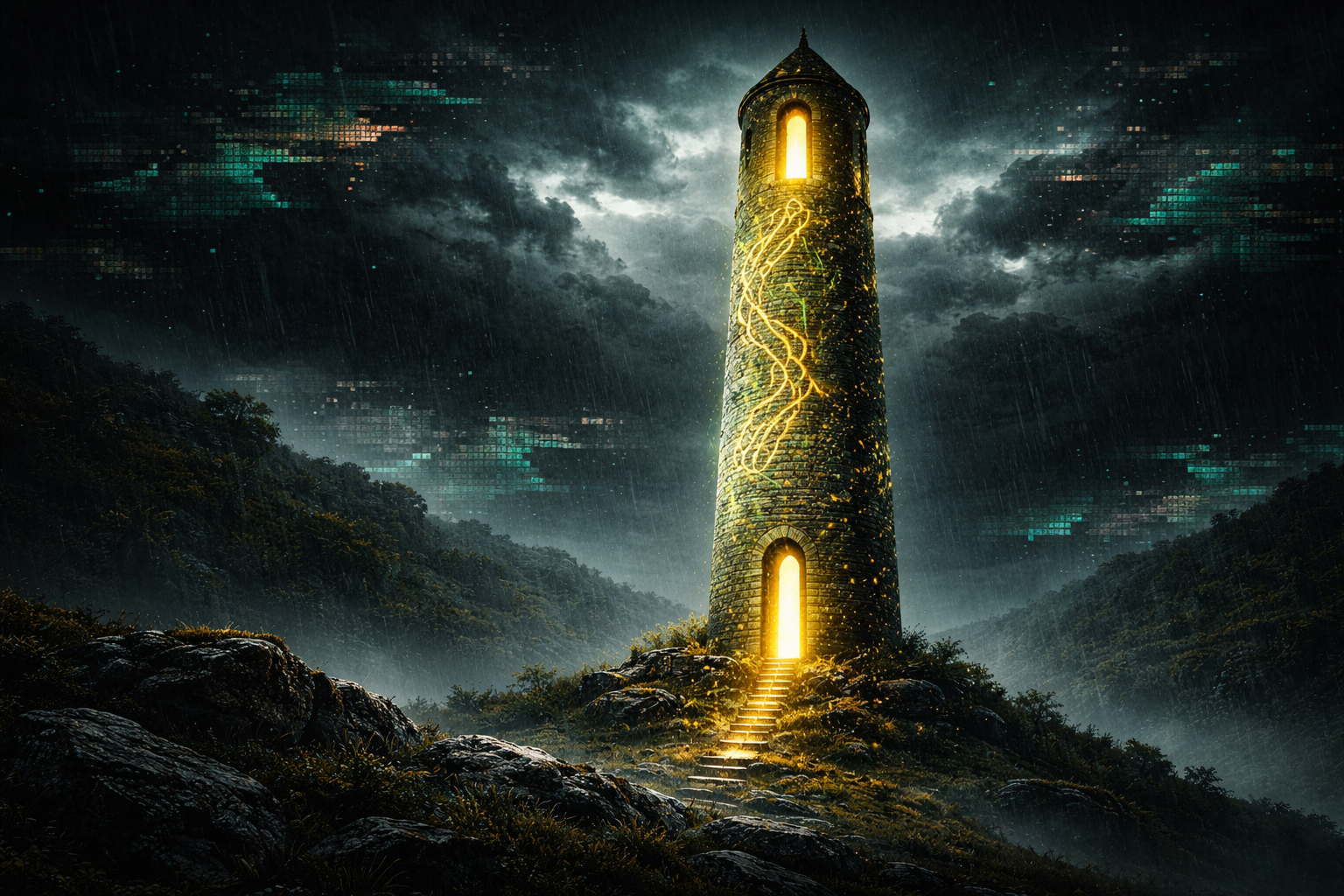
The Irish monks, in the centuries after Lindisfarne, developed a solution that was simple and elegant and — this is the part I keep coming back to — did not require them to stop being monks. They built round towers.[6] Tall, tapered stone cylinders, anywhere from sixty to one hundred and twenty feet high, with a single doorway set four to eight feet above ground level. The doorway was reachable only by a removable wooden ladder. When a raid began, the monks climbed the ladder, pulled it up behind them, and waited. The knowledge was still there. The manuscripts were still there. The community was still there. The knowledge was just harder to reach — elevated, vertical, no longer lying flat on the ground where anyone who wanted it could simply walk up and take it.
The round tower worked because the Vikings were a temporary threat. They came, they took what was available, they left. The monks came down. The ladder went back. The door opened again. The tower's genius was that it preserved the community's function — openness, accessibility, the ongoing work of copying and teaching — through a crisis without permanently transforming that function into something else. The defense was reversible. The openness, when the raid was over, was restored.
The AI scrapers are not a temporary threat. They do not leave. There is no morning after the raid when the monks climb down and find the countryside quiet. The siege is the permanent condition now, which means the defenses have to be permanent too, and this is where the round tower metaphor — which I have been developing with some satisfaction — begins to crack under the weight of the actual situation.
Because here is the thing about pulling up the ladder: when you pull it up, you also prevent people who haven't arrived yet from getting in. The wiki community is not just the people who are already inside. It is also, crucially, the people who are currently outside — who are readers today and might become editors tomorrow, who are hovering at the threshold of participation, who will cross that threshold or not depending on how much friction stands between them and their first edit. The pipeline from "person who found the wiki useful" to "person who contributes to the wiki" is the mechanism by which the community reproduces itself, by which the institutional knowledge doesn't die with the people who currently hold it. You protect the manuscripts by protecting the conditions under which new monks can be made.
One of the largest wiki hosting operators, Fandom, did pull up the ladder — implementing a login requirement as a bot mitigation strategy. It worked, in the narrow sense that it reduced bot load. It also, according to documented observation, correlated with a roughly forty-percent decline in new contributor activity.[7] Forty percent. The defense worked. The community it was defending began to die of it. The round tower, pulled up indefinitely, becomes a vault: the knowledge is preserved, but the conditions for its ongoing creation are severed. What you end up with is an archive, not a community. And an archive, without the community that interprets and updates and argues about and extends it, is a manuscript that nobody is copying anymore — which is precisely the condition that produces dark ages.
So the available defenses form a grim spectrum. On one end: do nothing, and the siege wins directly — the server goes down, stays down, and the wiki simply stops existing as a functional resource. On the other end: lock everything down, require authentication for access, and the siege wins indirectly — the wiki technically survives but the community that made it meaningful is gradually suffocated by friction. In between: an exhausting, continuous, technically sophisticated arms race against attackers who are invisible, who have essentially unlimited resources and no accountability, and who get more sophisticated every year while the defenders remain a small group of volunteers with finite time and bandwidth bills that keep going up.
ᛜ
But here is the thing about the Vikings that the raid narrative tends to obscure: they eventually settled down. The Viking Age does not end because the Norse were defeated or because raiding stopped working. It ends because the raiders became settlers. The Normans — Norsemen, same people, one century of residency in France — became the most sophisticated administrators in medieval Europe, built the most ambitious cathedrals, invented bureaucratic and legal infrastructure that shaped the post-Roman West for a thousand years. The grandchildren of the men who burned Lindisfarne commissioned illuminated manuscripts of their own. The transformation was not fast, not clean, not without ongoing violence. But it happened, because the relationship between the raiders and the thing they were raiding changed: they started living in the landscape they had been treating as something external to take from, and discovered that the logic of stewardship was not just morally superior but practically necessary for anyone who intended to stay.
The AI companies are going to stay. They are not going to stop needing training data. The question is whether they will develop a relationship with the infrastructure they depend on — whether, and how fast, they will become settlers.
Wikipedia is showing one way. The Wikimedia Foundation makes the entire Wikipedia database available for bulk download — not a curated sample, not a commercial license, but all of it, in structured XML, updated monthly, freely available to anyone who wants it.[8] The stated purpose is explicit: please do not hammer the live servers; here is exactly what you would need instead. This is stewardship logic applied directly to the extraction problem. We know you want the data. Here is the data. Take it through the door we built for this purpose, and leave the server alone. It is the round tower solution that doesn't require pulling up the ladder — the bulk data is outside the walls, in an orderly pile, and the door inside the tower stays open. Wikidata extends this further: not just dumps, but structured, queryable, machine-readable knowledge, built and maintained by the same volunteer community, offered freely to the machines that need it in machine-readable form because the alternative is those machines taking it badly.
These are invitations. They are expensive to build and expensive to maintain, and they represent the infrastructure commons making a unilateral decision to accommodate the extraction in the hope — not a guaranteed outcome, but a hope — that accommodation will eventually produce settlers. Settlers who understand that the wiki they are training on is not a static dataset but a living community, and that the community's continued existence is a precondition for the data remaining valuable, and that you cannot extract indefinitely from a thing you are simultaneously destroying.
Noisebridge already has the backup. The mirror exists. I made it. The data is sitting in a database right now, eighteen years of institutional memory, structured and queryable. The question of whether to put it outside the walls — to make it available in bulk, with a sign that says take it this way — is not a technical question. It is a question about what kind of relationship we want to have with the forces that are currently sieging us, and whether we believe those forces are capable of learning to be settlers, and whether we are willing to do the work of making it easier for them to become one.
What does a round tower look like in 2026? Not a tower you can climb down from when the raid is over — because the raid is not going to be over. A tower that somehow remains a door. A defense that somehow does not become the thing it's defending against. I don't know what this is. I'm not sure anyone does yet. But I think naming the problem correctly — not "our wiki goes down sometimes" but "the open web is under structural attack by forces that the architecture of openness has no answer to" — is the necessary first step toward building something that might actually work.
The monks built round towers while simultaneously continuing to copy manuscripts. The ladder came down every morning. The knowledge kept moving. They didn't solve the problem permanently — the Viking Age lasted three hundred years — but they found something that worked well enough, for long enough, to matter, and they did it without transforming themselves into something unrecognizable in the process. The Book of Kells exists because people kept making choices, under sustained duress, about what was worth protecting and at what cost. We're going to have to make those choices too. I think they are going to be harder than the monks' choices, and I think the margin for getting them wrong is narrower, and I think the time to start making them seriously is not after the next outage but right now, while we still have something left to protect.